Investigating the role of fluctuating hydrodynamics (FHD) in chaotic quantum systems
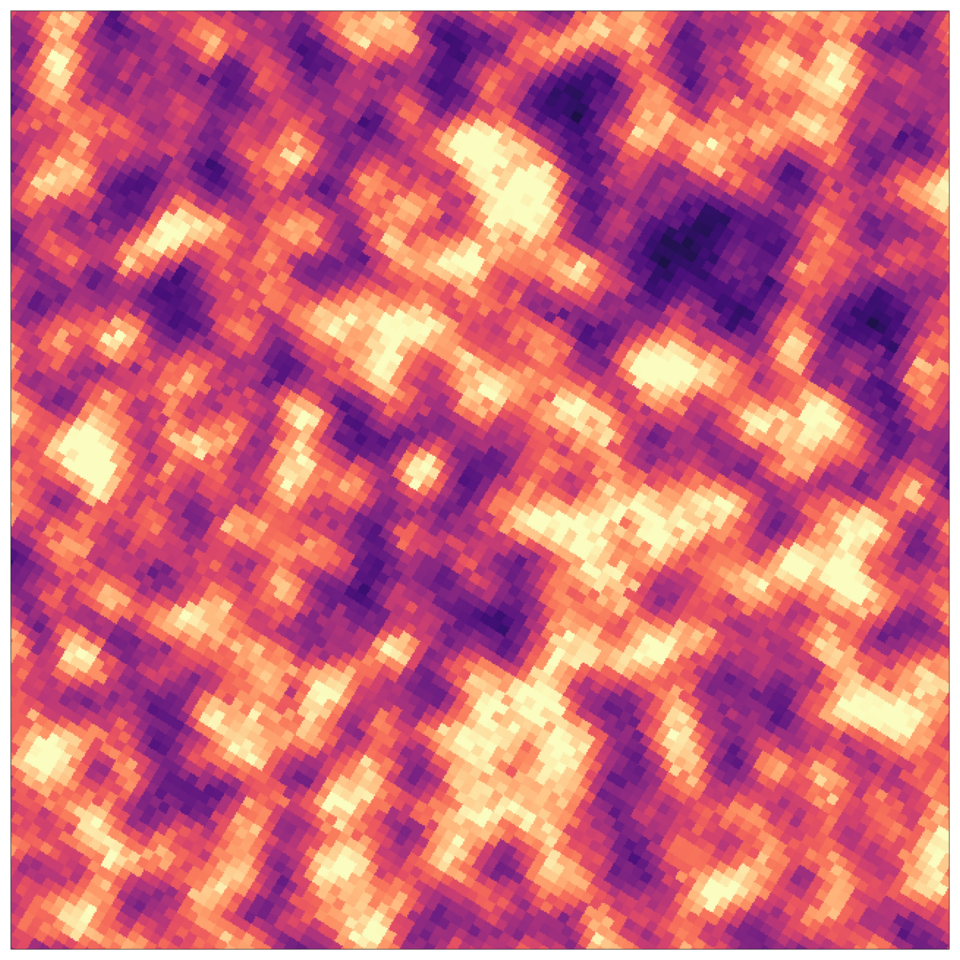
Our experimental results on the application of FHD to describe chaotic quantum systems have been published in Nature Physics!
A fundamental principle of chaotic quantum dynamics is that local subsystems eventually approach a thermal equilibrium state. The corresponding timescales increase with subsystem size as equilibration is limited by the hydrodynamic build-up of fluctuations on extended length scales. We perform large-scale quantum simulations that monitor particle-number fluctuations in tunable ladders of hard-core bosons and explore how the build-up of fluctuations changes as the system crosses over from integrable to fully chaotic dynamics. Our results indicate that the growth of large-scale fluctuations in chaotic, far-from-equilibrium systems is quantitatively determined by equilibrium transport coefficients, in agreement with the predictions of fluctuating hydrodynamics. This emergent hydrodynamic behaviour of subsystem fluctuations provides a test of fluctuation–dissipation relations far from equilibrium and allows the accurate determination of equilibrium transport coefficients using far-from-equilibrium quantum dynamics.
Snapshot of the density distribution of Cs atoms after time evolution.
Original publication:Emergence of fluctuating hydrodynamics in chaotic quantum systemsJulian F. Wienand, Simon Karch, Alexander Impertro,Christian Schweizer, Ewan McCulloch, Romain Vasseur, Sarang Gopalakrishnan, Monika Aidelsburger & Immanuel Bloch