Probing quantum many-body dynamics using subsystem Loschmidt echos
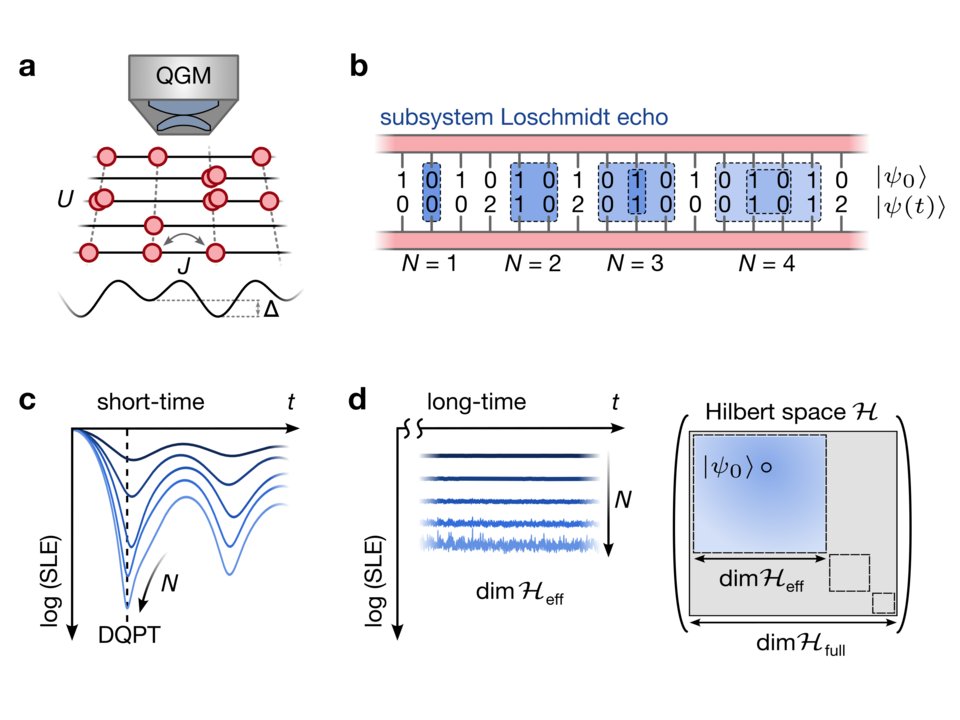
Using a caesium quantum gas microscope (a), we obtain snapshots of the time-evolved wavefunction from which we calculate the subsystem Loschmidt echo (b). We then probe its short- and long-time dynamics (c, d).
The Loschmidt echo is a fundamental concept in statistical physics, capturing the probability of a system returning to its initial state following a time evolution. It generally contains key information about a quantum many-body system, relevant across various scientific fields including quantum chaos, quantum many-body physics, or high-energy physics. While widely used in theoretical studies, direct experimental measurements of the Loschmidt echo are typically infeasible since it is exponentially small in system size.
In our work, we demonstrate how this challenge can be overcome by experimentally studying the subsystem Loschmidt echo — a powerful and experimentally accessible probe of quantum many-body dynamics.
Utilizing our caesium quantum gas microscope, we study the short- and long-time dynamics of the subsystem Loschmidt echo following a sudden quench in a one-dimensional Bose-Hubbard model. In the short-time regime, we use the subsystem Loschmidt echo to observe a dynamical quantum phase transition and show that it arises due to genuine higher-order correlations in the system. In the long-time regime, the subsystem Loschmidt echo allows us to quantify the effective dimension and structure of the accessible Hilbert space in the thermodynamic limit. By measuring the steady-state value of the subsystem Loschmidt echo in an ergodic model and in the presence of emergent kinetic constraints, we provide direct experimental evidence for ergodicity breaking due to fragmentation of the Hilbert space.