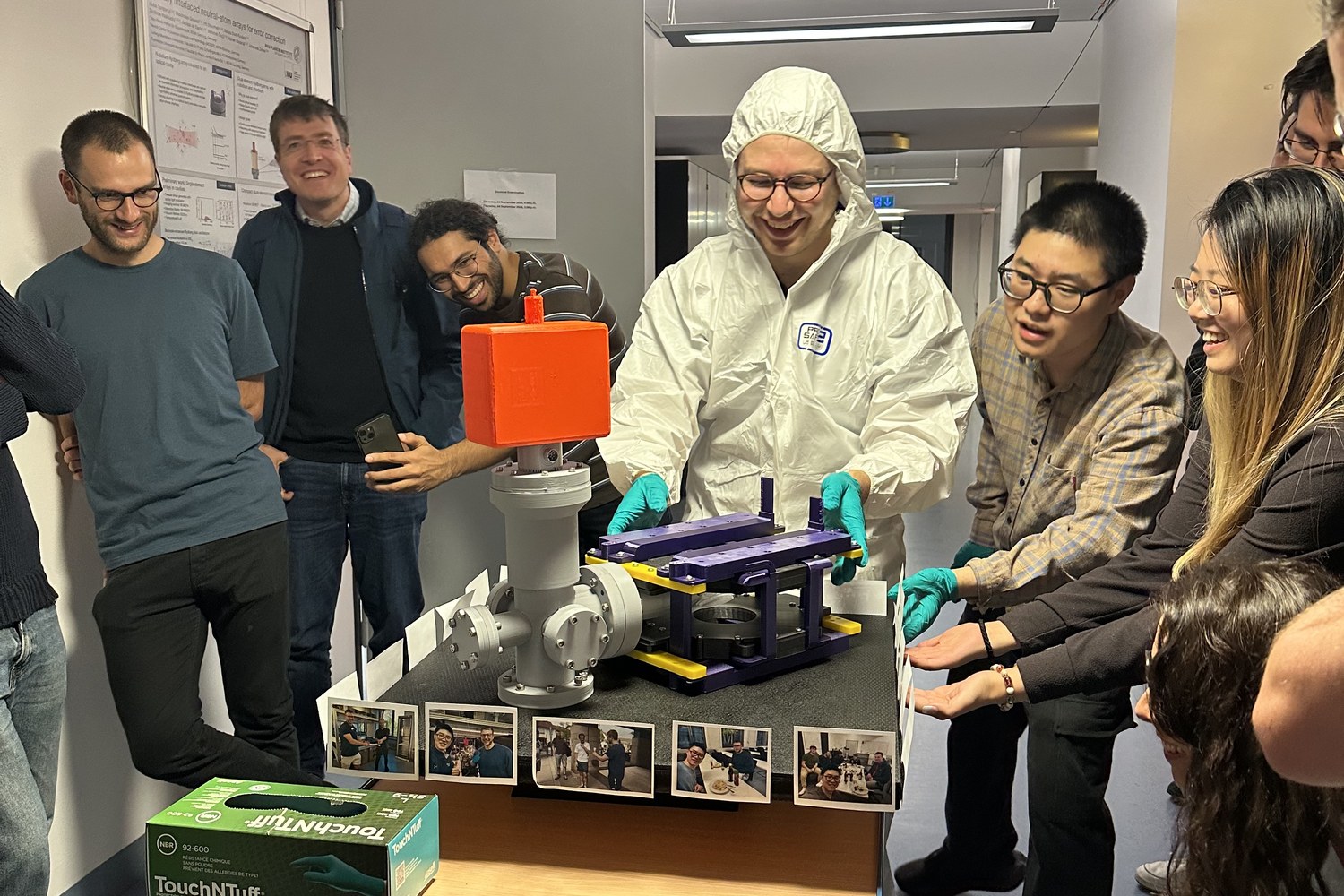
Bodo Kaiser successfully defended his PhD thesis!
Bodo successfully defended his PhD thesis. He did his doctoral work on the Ryd-Yb tweezer array experiment.
Neutral-atom arrays have gained increasing importance in the development of quantum computing architectures. Alkaline-earth(-like) atoms such as Yb offer unique opportunities for high-fidelity detection via shelving, trapping of Rydberg states and high-fidelity single-photon Rydberg excitations.
In this project we build a programmable array of individually trapped Yb atoms and use Rydberg interactions to implement high-fidelity entangling gates and analog quantum simulation of spin models.
Neutral-atom arrays have gained increasing importance in the development of quantum computing architectures. More recently, high-fidelity single- and two-qubit operations have also been demonstrated with alkaline-earth(-like) atoms (AELA), which offer unique opportunities for high-fidelity detection via shelving, trapping of Rydberg states and high-fidelity single-photon Rydberg excitations. As part of the Munich Quantum Valley (MQV) we are currently building a new tweezer-array platform, where single fermionic 171Yb atoms are trapped in optical tweezers and interactions are induced via highly-excited Rydberg states.
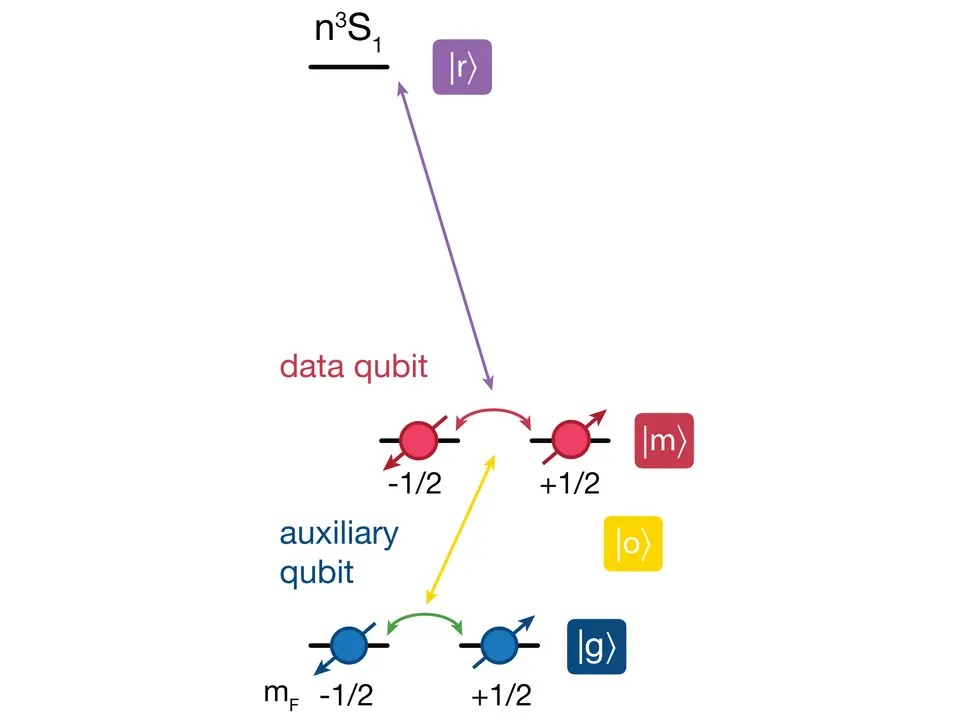
Neutral Yb atoms have two valence electrons, hence the level structure decomposes into singlet and triplet states. The absolute ground state 1S0 is labeled |g⟩ and the excited clock state 3P0 |m⟩. The optical transition connecting the two clock states is weakly allowed for the fermionic isotopes with an ultranarrow linewidth, which is used in optical lattice clocks, forming the optical qubit |o⟩. The unique feature of the fermionic isotope 171Yb is that it has a nuclear spin I=1/2, which supports multiple qubit encodings.
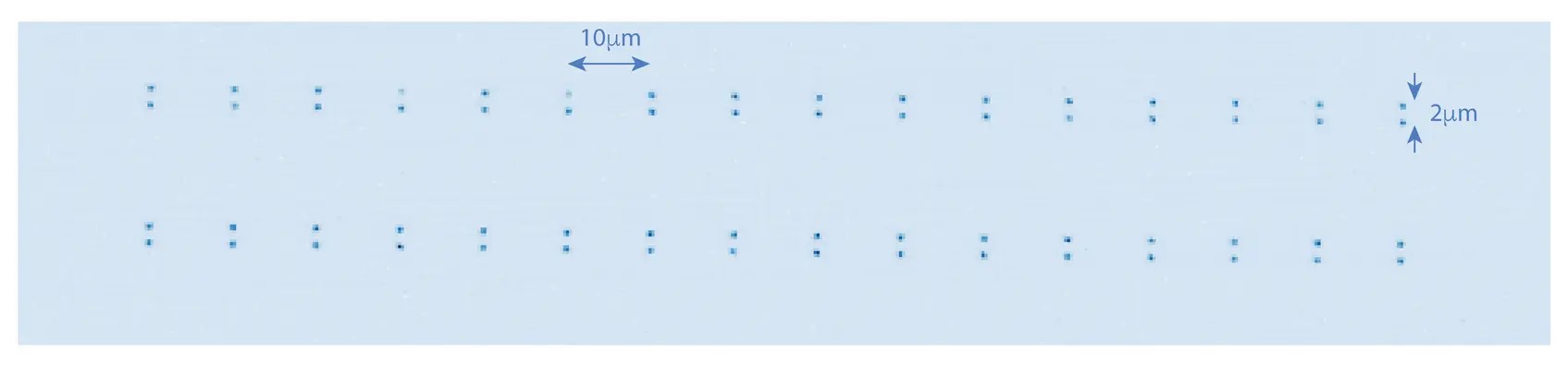
In order to achieve high-fidelity control on the optical clock transition, we work with tweezer traps at the clock-magic wavelength of 759 nm, where the differential light shift for that transition vanishes. The atoms are loaded from a magneto-optical trap operating on the 1S0 → 3P1 transition, with enhanced loading fidelities of about 80%.
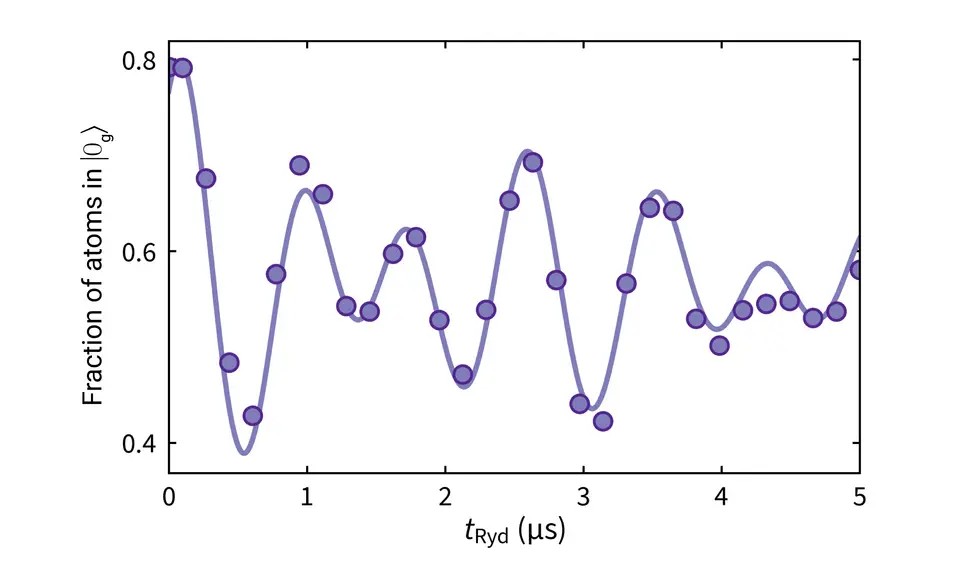
We group the atoms into pairs to study Rydberg-mediated interactions between neighboring sites. When driving the excitation to a Rydberg state, we observe the first signatures of pair interactions. For neighboring pairs, the Rabi coupling is enhanced by a factor of √2, reflecting the strong interactions between atoms in the excited Rydberg level. The resulting signal exhibits a characteristic beating pattern arising from singly and doubly occupied neighboring tweezers.
Bodo successfully defended his PhD thesis. He did his doctoral work on the Ryd-Yb tweezer array experiment.
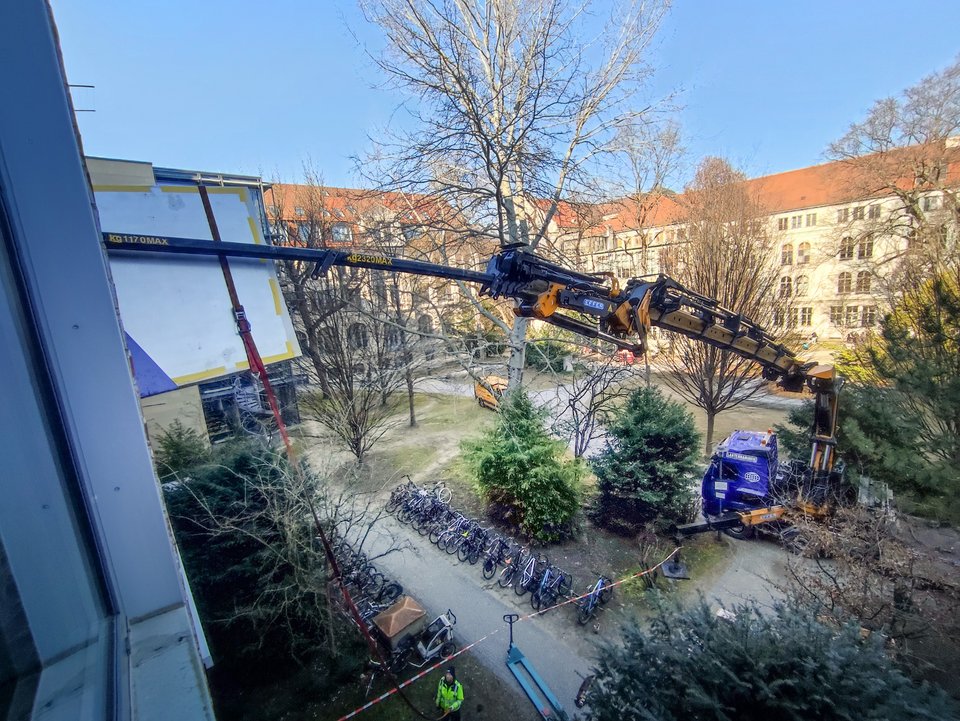
Today our new optical table for the Ryd-Yb lab was delivered. We are excited to finally start setting up our new lab!Click on the images below to see how the table was moved into o…